
The 3 - Step Brand Positioning Playbook Every Small Business Owner Needs
Most buyers decide whether your business is for them in under eight seconds, and a vague, everyone-friendly promise loses that moment every time. This playbook covers three steps small business owners can finish in a weekend: narrow to one specific buyer, claim a position competitors can't copy, and push that position into every touchpoint. Includes templates, examples, and a 48-hour sprint plan.
@admin
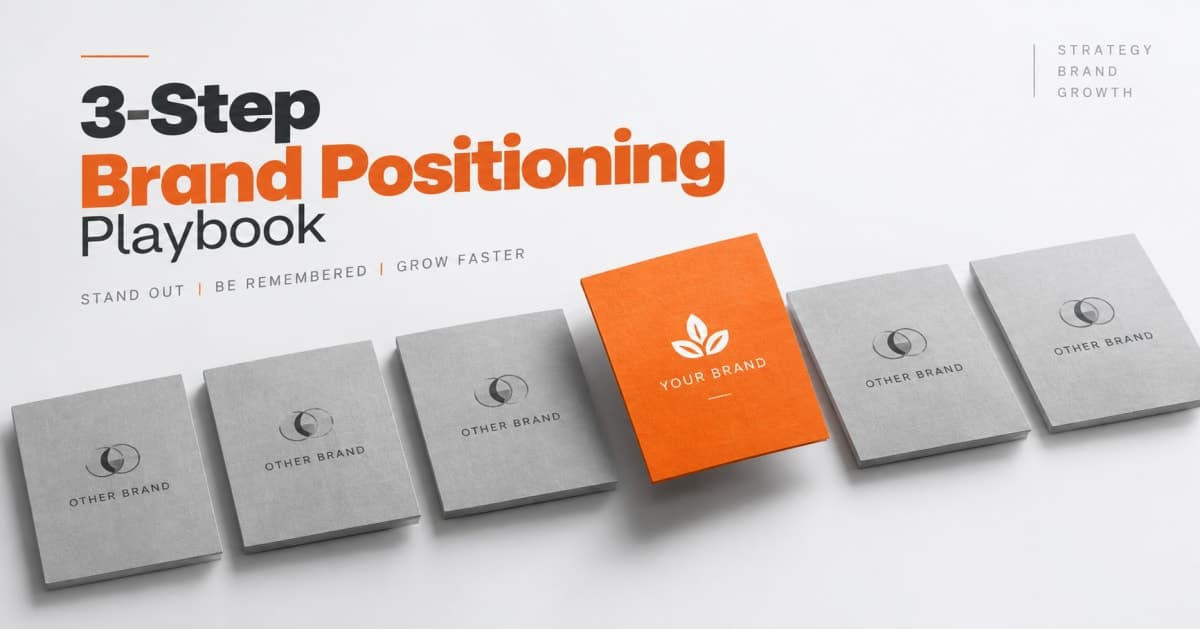
A stranger lands on your homepage. They read your headline, glance at your logo, scan one line of copy, and decide whether you're worth another thirty seconds. Most of them decide no.
That decision has almost nothing to do with how good your work is. It has everything to do with how quickly a visitor can answer one question: is this for someone like me? Brand positioning for small business owners is the work of making that answer obvious before anyone reads a second paragraph.
This playbook walks through three steps you can complete in a weekend: choosing the one buyer you're for, claiming a position your competitors can't copy, and pushing that position into every place a customer sees you. No agency retainer, no rebrand, no new logo required.
Buyers Decide Before They Read a Word
Watch someone browse for a service provider and you'll see the same pattern every time. They open six tabs, spend four to eight seconds on each, close five of them, and read one properly.
In those few seconds they're processing three things: what you do, who you do it for, and whether you look like the safe choice. Everything else — your process, your credentials, your beautiful case studies — only gets read after you survive the scan.
Here's the trap most owners fall into. Trying to appeal to everyone, they write a headline like "Digital solutions for growing businesses." It's technically accurate and completely invisible. A promise that fits every buyer signals expertise in nothing, and buyers read it as exactly that.
It helps to separate two words people use interchangeably:
Positioning is a decision. It's the place you want to occupy in a buyer's head, and who you're willing to lose in order to own it.
Branding is the expression of that decision — name, logo, colours, tone, photography, pricing page.
Design without a decision behind it is decoration. That's why so many rebrands feel expensive and change nothing: the visuals got sharper while the underlying promise stayed as vague as it was before. Get the decision right and the design work becomes far easier, because you finally know what you're expressing.
Step 1 — Pick the One Person You're Actually For
"Small businesses" is not an audience. Neither is "SMEs in India" or "founders who want to grow." These are census categories. They tell you nothing about what someone is worried about at 11pm on a Tuesday.
A real audience has a situation and a trigger. Use this three-part narrowing test:
Industry or context — what world do they live in? (E-commerce, dental clinics, D2C skincare, SaaS.)
Situation — what stage or constraint are they in? (First year of operation, post-funding, scaling from 3 to 15 staff, preparing to sell.)
Trigger — what just happened that made them start looking? (A failed audit, a founder leaving, a bad quarter, a new compliance deadline.)
A worked example
A bookkeeper in Ahmedabad described herself as serving "small businesses and startups." Every proposal turned into a price comparison, because from the buyer's side she looked interchangeable with forty other bookkeepers.
Running the test, she landed on: Shopify sellers in their first year, dealing with GST filing for the first time.
Same skills. Same software. But now her homepage could say something no generalist could say, her onboarding could assume knowledge of order exports and marketplace fees, and her testimonials all came from people the visitor recognised as themselves. Her close rate roughly doubled inside two quarters, and she stopped getting asked to match the cheapest quote.
What you gain by losing most of the market
Narrowing feels like shrinking. On paper you just gave up 80% of the buyers you could technically serve. In practice you gave up 80% of the buyers who were never going to choose you anyway, and you became the obvious choice for the rest.
Three things get easier immediately:
Your marketing writes itself, because you know exactly what your buyer is googling at midnight.
Referrals get sharper. People can only refer you if they can describe you in one sentence.
Your pricing holds, because specialists aren't compared on price the way generalists are.
You can always serve clients outside the niche. You just shouldn't advertise to them.
Step 2 — Claim a Position Competitors Can't Copy
Now decide what you want to be known for. A strong position is one your two closest competitors would find awkward or expensive to claim. If they could copy your homepage headline tomorrow without changing anything about their business, you haven't positioned yet.
The four positions that still work
Most durable small business positions fall into one of four shapes:
The specialist. You do one thing for one kind of buyer. "Bookkeeping for Shopify sellers." Hard to copy because copying means abandoning other revenue.
The speed play. You deliver in days where the category takes weeks. Defensible only if your process genuinely supports it, so don't claim it unless it's operationally true.
The price anchor. You're deliberately the premium or the accessible option, and everything from packaging to payment terms reinforces it. Being mid-priced is not a position.
The point of view. You have a stated belief about how the work should be done, and you turn away clients who disagree. "We don't do retainers." "We build on Webflow only." A rival can copy the words but not the conviction, because their operations contradict it.
The competitor grid (20 minutes, free)
Open a spreadsheet. List your five closest competitors down the left. Then fill three columns for each:
Column | What to write |
|---|---|
Who they say they serve | Straight from their homepage, their words |
Their one-line promise | The headline above the fold |
Their proof | Case studies, logos, guarantees, credentials |
Read the promise column top to bottom. You'll usually find three or four of them saying near-identical things. The gap is whatever nobody in that column is willing to say. That empty space is your brand positioning strategy, sitting there for free.
Write it down in one sentence
Use this template:
For [specific buyer] in [situation], we're the [category] that [distinct promise] — unlike [alternative], which [limitation].
Two before-and-afters:
Before: "We're a creative agency helping brands tell their story." After: "For D2C skincare founders launching their first product, we're the packaging design studio that ships print-ready files in 14 days — unlike full-service agencies, which take three months and bill for strategy decks."
Before: "Reliable IT support for businesses of all sizes." After: "For dental clinics with 2–6 chairs, we're the IT partner that guarantees same-day on-site response — unlike remote helpdesks, which can't touch your imaging hardware."
Print the finished sentence. Tape it above your desk. Every decision in step three is measured against it.
Step 3 — Make the Position Visible in Every Touchpoint
A position nobody can see isn't a position. This step is where most owners stop, and it's why so many businesses have a great answer buried on page four of a strategy document while the homepage still says "welcome to our website."
The first screen
The area a visitor sees before scrolling carries more weight than the rest of your site combined. It needs three things:
A headline that states the promise, not your company name. State what you do and who for, in plain language a buyer would use themselves.
One line of support that handles the obvious objection — timeline, price range, or scope.
One action. A single button. Book a call, see pricing, or view work. Three competing buttons means no decision gets made.
Delete the rotating carousel. Nobody reads slide two.
Name, logo, colour, and type
Here's the uncomfortable truth about visual identity: your logo carries far less meaning than you think, and your consistency carries far more.
Colour does the heaviest lifting, because it's recognised before words are read. Pick one ownable primary colour and use it relentlessly. If three of your five competitors are blue, don't be the fourth.
Typography signals category more than personality. A geometric sans reads modern and technical; a serif reads established and considered. Choose based on the position, then stop choosing.
Photography either matches your buyer's world or quietly undermines you. Generic stock photos of people high-fiving in glass offices tell a dental clinic owner that you've never been inside a dental clinic.
Your name rarely needs changing. A descriptive tagline underneath it does the positioning work at a fraction of the cost.
[Alt: Brand positioning applied across homepage, business card, and pricing page]
Proof that matches the promise
Positioning collapses when your proof points the other way. If you claim to serve dental clinics and every case study on your site is a restaurant, the visitor believes the case studies.
Audit three things: which testimonials appear first, which logos you display, and how your pricing page is structured. Lead with the clients who look like the buyer you chose in step one. Retire the rest, even the impressive ones.
The consistency rule: your position should appear in the same words in six places — homepage headline, about page, pricing page, email signature, social bios, and the sentence you say out loud when someone asks what you do. Different wording in each place reads as six different businesses.
How to Test Whether Your Positioning Is Working
You don't need a research budget. You need five strangers and five seconds.
The five-second test. Show someone your homepage for five seconds, close the laptop, and ask two questions: what does this business do, and who is it for? If they can't answer both, the problem is the first screen, not your traffic.
Then watch for three signals over the next 60–90 days:
Better-fit leads. Fewer enquiries overall, more of them from the buyer you named. A drop in raw enquiry volume is expected and usually healthy.
Shorter sales conversations. When positioning does its job, prospects arrive already convinced you're relevant and only need to confirm details.
Fewer price objections. "Why are you more expensive than X?" fades when buyers stop seeing you and X as the same thing.
Revisit your positioning when your market genuinely shifts, when you outgrow the niche, or when the signals above flatline for two quarters straight. Otherwise leave it alone. Positioning compounds through repetition, and owners who rewrite their promise every few months never give it time to stick.
Your 48-Hour Positioning Sprint
You can do all three steps this weekend.
Hours 1–2: Run the narrowing test. Write down one buyer, one situation, one trigger.
Hours 3–4: Build the competitor grid for five rivals. Find the empty column.
Hour 5: Write your positioning sentence using the template.
Hours 6–8: Rewrite your homepage first screen — headline, support line, one button.
Day 2: Push the same sentence into your about page, pricing page, email signature, and social bios. Reorder your testimonials.
The one thing to remember: positioning is a decision about who you're willing to lose, and until you make it, no amount of design will make you memorable.
Start with the five-second test today. Send your homepage to three people who don't know your business, give them five seconds, and ask them who it's for. Their answer tells you exactly how much of this playbook you need.
Keep Learn Admin
Author
This author hasn’t added a bio yet.
Editorial Discussion
0 Contributions Recorded
Join the Editorial Discussion
Identity verification is required to participate in discussions and post comments.
Verify & Sign In